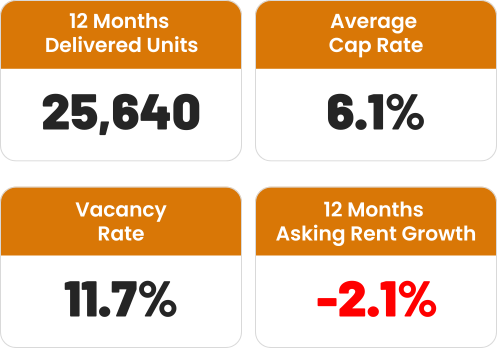
The Phoenix apartment market is facing a supply-demand imbalance, with strong demand being overshadowed by a surge in construction. Over the past year, 19,000 units were absorbed, exceeding pre-COVID averages. However, the completion of 25,000 new units has pushed vacancy rates to 11.7%. While luxury developments are driving much of the activity, midpriced communities are seeing some recovery, and workforce housing remains relatively insulated from supply pressures.
Despite improving demand, competition remains fierce, with vacancies rising across all property types. Rent growth has been negative since early 2023, and more than 50% of properties are offering concessions. A slowdown in construction is expected by 2026, which may ease supply pressures and help the market recover. However, the oversupply of units is likely to keep rent growth subdued in the short term.
Phoenix MULTIfamily Market FAQ
1. What is the current state of the Phoenix apartment market?
The Phoenix apartment market is facing a supply-demand imbalance. While demand has improved, a wave of new construction has overshadowed this, resulting in elevated vacancy rates and negative rent growth.
2. How much net absorption has occurred in the past year?
Over the past 12 months, the Valley recorded 19,000 units of net absorption, which is significantly higher than the pre-COVID five-year annual average of 7,200 units. The majority of this activity has been driven by newly delivered luxury complexes, with midpriced communities also showing signs of recovery.
3. Why are vacancy rates rising?
Despite strong leasing activity, vacancy rates have increased due to the completion of 25,000 new units in the past year—more than triple the average annual completion from 2015 to 2019. This surge in construction has outpaced demand, pushing overall vacancy to 11.7%, with expectations for it to rise further as more units are completed.
4. What areas are seeing the most construction?
High-growth areas like Downtown Phoenix, Tempe, and the South West Valley are seeing the most new construction, with the South West Valley recently becoming the top construction submarket.
5. How are different property types performing?
Luxury properties have seen vacancies rise by over 700 basis points, with rents declining by 2.4% year-over-year. In contrast, workforce housing (1 & 2 Star properties) has seen vacancy rise by 420 basis points, and rents have fallen by 0.3%. Midpriced communities (3 Star properties) are showing recovery, with 4,200 units of net absorption over the past year.
6. How are rent prices and concessions affected?
Rent growth has been negative since early 2023, with average asking rents falling by 2.1% in the past year. More than 50% of apartment communities are offering some form of discount, with prospective renters receiving six to eight weeks of free rent at properties in lease-up.
7. What is expected for the future of the market?
A pullback in construction starts by 2026 is expected to ease supply pressures, which should help the market recover. However, a large excess of inventory still needs to be absorbed, meaning rent growth is expected to remain modest in the near term.
8. How does this affect prospective renters?
Renters can expect to see significant competition in the market, especially in newly developed properties, where concessions like free rent and rent discounts are common.

