The Phoenix multifamily market is making progress toward recovery as 2024 comes to a close, supported by easing inflation and rising consumer confidence. These factors have reignited renter household formation, leading to a rebound in tenant demand. Over the past 12 months, Phoenix recorded 20,000 units of net absorption, significantly outpacing the pre-COVID five-year annual average of 7,200 units. Notably, mid-priced 3 Star properties have shown a strong turnaround, absorbing 5,000 units after years of negative net absorption.
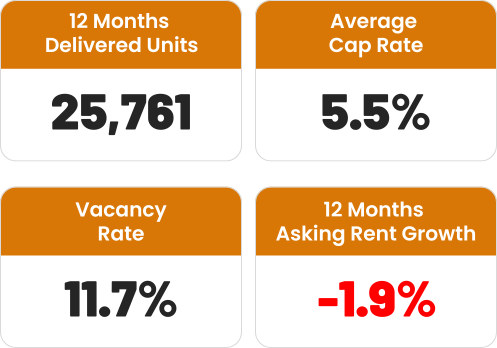
Despite these positive trends, the market faces challenges from a construction surge. Builders delivered 25,000 new units in the past year—more than three times the annual average from 2015 to 2019. An additional 27,000 units are under construction, representing 6.7% of existing inventory and ranking Phoenix as the sixth most aggressively built apartment market in the U.S. This oversupply has pushed the metro-wide vacancy rate to 11.5%, with high-growth areas like Downtown Phoenix, Tempe, and the South West Valley seeing the most accumulation of empty units.
Market performance has varied by property type. Workforce housing has been more insulated from supply pressures, with vacancy rates rising modestly and rents showing a slight positive growth of 0.09% over the past year. In contrast, luxury properties have faced steeper challenges, with vacancy rates exceeding pre-pandemic highs by over 600 basis points and rents declining by 2.6% year-over-year.
Heightened competition has led to widespread rent concessions, with many properties offering up to eight weeks of free rent in lease-ups and four weeks at stabilized communities. Over 40% of properties are now offering some form of discount, reflecting the market's struggle to balance supply and demand.
Looking ahead, the market is expected to face peak vacancy rates in 2025, with a gradual recovery anticipated by the end of the year. However, meaningful rent growth may take longer to materialize as the oversupply from recent years is absorbed. By 2026, the market is expected to stabilize, with vacancy rates compressing and rent growth regaining momentum.
Despite current challenges, Phoenix remains a dynamic and evolving market with strong long-term growth potential. Investors and developers who navigate the current conditions strategically will be well-positioned to benefit from the market's recovery and future opportunities.
Phoenix MULTIfamily Market FAQ
1. What is the current state of the Phoenix multifamily market?
The Phoenix multifamily market is showing signs of recovery in 24Q3. Easing inflation and rising consumer confidence have boosted renter demand, resulting in 20,000 units of net absorption over the past 12 months. However, vacancy rates remain elevated at 11.5%, largely due to a surge in new construction.
2. How does the current net absorption compare to pre-COVID levels?
Net absorption over the past year has outpaced pre-COVID five-year annual averages of 7,200 units, marking a significant improvement in tenant demand.
3. What property segments are performing best?
Midpriced 3 Star properties have shown a strong recovery, absorbing 5,000 units in the past year. Workforce housing has also remained relatively stable, with slight positive rent growth of 0.09%.
4. How is the luxury segment performing?
Luxury properties are facing challenges, with vacancy rates over 600 basis points higher than pre-pandemic levels. Rents in this segment have declined by 2.6% year-over-year, and concessions are widespread.
5. How has construction activity impacted the market?
Construction has surged, with 25,000 new units delivered in the past 12 months and 27,000 more under construction. This represents 6.7% of existing inventory and has contributed to elevated vacancies, particularly in high-growth areas like Downtown Phoenix, Tempe, and the South West Valley.
6. Are rent concessions common in the current market?
Yes, rent concessions have increased significantly. Over 40% of communities are offering discounts, with many properties providing six to eight weeks of free rent for lease-ups and four weeks for stabilized units.
7. What is the outlook for the Phoenix multifamily market?
Vacancy rates are expected to peak in 2025, with gradual recovery anticipated by the end of the year. Rent growth may remain subdued in the near term but is expected to accelerate by 2026 as the market adjusts to oversupply and vacancy rates begin to compress.
8. Is the Phoenix multifamily market still a good investment opportunity?
Despite current challenges, Phoenix remains a high-growth market with strong long-term potential. Strategic investments in well-positioned properties and segments like workforce housing could yield favorable returns as the market stabilizes and recovers.
:format(webp):quality(80)/u.realgeeks.media/capcorerealestate/badge_trans.png)
:format(webp):quality(80)/u.realgeeks.media/capcorerealestate/Facebook.jpg)