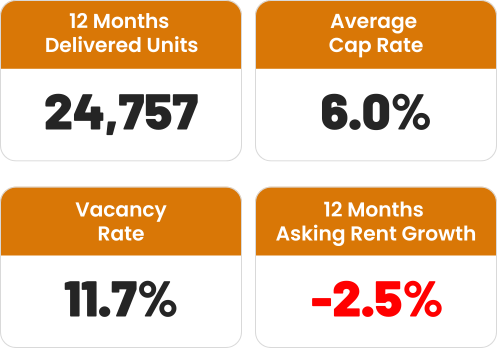
The Phoenix apartment market remains under pressure from a significant oversupply, despite strong leasing activity. In the past year, the market absorbed 18,000 units—well above the pre-COVID average—driven by a rebound in demand for mid-tier (3-Star) properties. However, this demand has been overshadowed by the completion of 25,000 new units, with another 23,000 still under construction. As a result, the overall vacancy rate has climbed to 11.7%, particularly in high-growth areas like Downtown Phoenix, Tempe, and the Southwest Valley.
Luxury properties have been the most affected, with vacancy rates rising sharply and rents falling by 2.7% year-over-year. Workforce housing has been more stable, experiencing only a slight dip in rents. To stay competitive, more than half of all communities are offering concessions, with lease-up properties commonly providing 6–8 weeks of free rent. While construction starts are slowing—suggesting future relief—excess inventory is likely to keep rent growth subdued through 2025, with a potential recovery expected by 2026.
Phoenix MULTIfamily Market FAQ
1. Why is the Phoenix apartment market struggling?
A mismatch between strong leasing demand and an overwhelming surge in new construction has kept vacancies high and rent growth negative.
2. How much demand is there currently?
The market saw 18,000 units of net absorption in the past 12 months—well above the pre-COVID average of 7,200 units per year.
3. What types of apartments are seeing the most demand?
Midpriced (3 Star) communities saw the biggest turnaround, absorbing 3,800 units after experiencing losses in 2022 and 2023.
4. How many new apartments were built recently?
25,000 new units were delivered in the last year—over three times the 2015–2019 average—and another 23,000 units are under construction.
5. What is the current vacancy rate?
Vacancy has climbed to 11.7% and may increase further as more units are completed in 2025.
6. Which areas are most affected by oversupply?
High-growth zones like Downtown Phoenix, Tempe, and the Southwest Valley are seeing the most new construction and vacant units.
7. Are all property types equally impacted?
No. Luxury properties have seen the biggest declines in occupancy and rent, while workforce housing (1 & 2 Star) has been more stable, with smaller rent drops and less vacancy increase.
8. Has rent growth turned negative?
Yes. Average asking rents declined 2.5% year-over-year, and luxury properties fell by 2.7%. Rent growth has been negative since early 2023.
9. Are concessions being offered to renters?
Yes. Over 50% of communities now offer incentives, with many providing 6–8 weeks of free rent for new leases.
10. What’s the future outlook for the market?
A slowdown in new construction could ease supply pressures by 2026. However, with a significant amount of excess inventory still on the market, rent growth is expected to stay weak through 2025.
:format(webp):quality(80)/u.realgeeks.media/capcorerealestate/badge_trans.png)
:format(webp):quality(80)/u.realgeeks.media/capcorerealestate/Facebook.jpg)