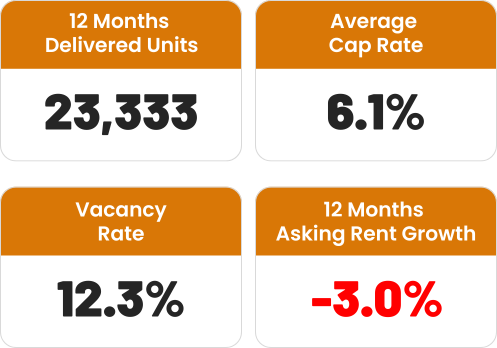
The Phoenix apartment market continues to face an imbalance between supply and demand. Despite solid leasing activity—17,000 units absorbed in the past year, more than double the pre-COVID average—record construction levels are keeping vacancy rates high (12.1%) and rent growth negative.
Over the past 12 months, 23,000 new units were delivered, triple the typical annual volume from 2015–2019, with another 21,000 units under construction. This surge places Phoenix among the top six most actively built apartment markets in the U.S., particularly in Downtown Phoenix, Tempe, and the Southwest Valley, where empty units are accumulating.
The excess supply has intensified competition, leading to a 3% drop in asking rents and widespread rental concessions, often offering six to eight weeks of free rent. Rent declines now affect both luxury (4 & 5 Star) and workforce (1 & 2 Star) properties alike.
Looking ahead, construction starts are slowing, which could ease supply pressures by 2026. However, with a large backlog of new inventory, vacancies and rent softness are expected to persist through 2025, with a gradual recovery anticipated in 2026.
Phoenix MULTIfamily Market FAQ
1. What is currently affecting the Phoenix apartment market?
A major imbalance between supply and demand is impacting the market. A record level of new apartment construction is outpacing tenant demand, leading to higher vacancy rates and negative rent growth.
2. How strong is apartment demand in Phoenix?
Demand remains solid, with 17,000 units absorbed in the past 12 months — more than double the pre-COVID annual average of 7,200 units. This makes Phoenix one of the top 10 U.S. markets for apartment demand.
3. Why are vacancies still high despite strong demand?
Developers completed 23,000 new units over the past year — more than triple the pre-2019 average. With 21,000 more units still under construction, vacancies have risen to 12.1% and are expected to stay elevated as more supply hits the market.
4. Which areas are most affected by oversupply?
High-growth areas such as Downtown Phoenix, Tempe, and the Southwest Valley are seeing the highest number of empty units due to heavy construction activity.
5. How is rent growth performing?
Rents have declined by 3% over the past year, and over 50% of apartment communities now offer discounts or free rent incentives — often six to eight weeks free for new leases.
6. Are all property types affected by rent declines?
Yes. Both luxury (4–5 Star) and workforce (1–2 Star) apartments are seeing rent losses. Rent fell 3.1% for high-end complexes and 1.8% for lower-tier communities.
7. What’s the outlook for the next few years?
Construction starts are slowing, which should help balance supply and demand by 2026. However, due to excess inventory, negative rent growth is expected to continue through 2025, with a gradual recovery beginning afterward.
:format(webp):quality(80)/u.realgeeks.media/capcorerealestate/badge_trans.png)
:format(webp):quality(80)/u.realgeeks.media/capcorerealestate/Facebook.jpg)